Bridge Magazine – 2020
Firstly, let me define “short hand”. When you are playing in a trump contract, we call the hand (declarer or dummy) with the longer trumps the long hand and the hand with the shorter trumps the short hand.
Some ruffs you aim for and some you have forced upon you. The ones you aim for either create extra tricks or are worth extra tricks in their own right. Ruffs in the short hand are very often worth extra tricks in their own right.
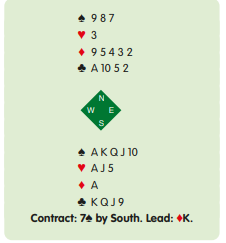
Spades are trumps and your target is thirteen tricks. You have a singleton in each hand, but you do not try to ruff in both hands generally you go for ruffs in the short hand. You start with five trump tricks but need more. Ruffing hearts in the short hand is the way to do this. Each time you ruff a heart you make an extra trick as you still have five trump tricks in your hand.
How different the case is if you try to ruff diamonds in the South hand. Now instead of gaining a trick, you are just making the same five trumps only as four top trump tricks and a ruff. Indeed, not only do you not gain a trick, but you also shorten your trumps. This could prove disastrous as you can see from the full diagram.
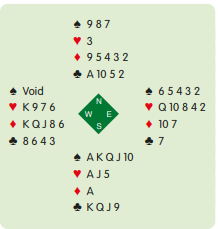
The play is simple if you focus on ruffing in the short hand. You have eleven top tricks and need just two ruffs. Take the red aces, ruff a heart, and come to hand with a trump, on which West shows out. Then ruff another heart, come to hand with a club, and finish drawing trumps. Your good clubs win the last three tricks. Eleven tricks become thirteen by ruffing twice in the short hand. Just one diamond ruff in the long hand and you would have lost control as East would have more trumps than you. Seldom will trumps break so badly, but you should avoid needless ruffs in the long hand.
Here is an example of ruffing in the short hand from a duplicate pairs event:
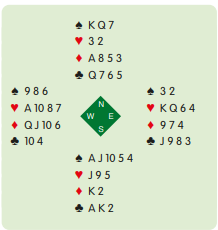
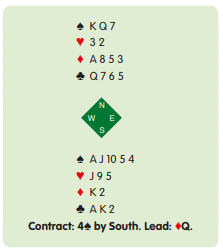
You count ten tricks on top and have a chance of an eleventh from your club suit. However, a 3–3 break is against the odds, so you would like a surer way of making an overtrick. Whenever you are looking for extra tricks, always consider ruffing in the short hand.
If you can ruff a heart in dummy, you make your eleventh trick. Win the first diamond in hand and give up a heart. Win the trump return in dummy and play another heart. Win the next trump in hand, ruff a heart in dummy, and cross to hand with a club to draw trumps. The defenders could have stopped you from making eleven tricks by leading a trump at trick one. Of course, as the clubs broke 4–2, there was no extra trick there. Once again, note that ruffing diamonds in the long hand would not gain tricks.
Conclusion
Ruffing in the short hand nearly always gains a trick, so you should always look for ways to do so in your plan. It is an especially useful tactic in pairs, where making overtricks can be very important. There are so many deals on which making that extra ruff will move you up the scoreboard.