Those of you who watched the European Bridge Championships on BBO cannot have helped but notice that hardly anyone, not even the British pairs, seemed to be playing Acol. Two of the three English open pairs were playing a strong no-trump and five-card majors, the third playing a variable no-trump again with five-card majors. All three of the Scottish open pairs were playing a strong no-trump and five-card majors, as were most of the Welsh line-ups. Even Standard American style seemed rare in the matches I watched.
Teams from the Balkans seemed to be playing Precision (where a 1♣ opening is strong and artificial) while those from Poland and its neighbours were playing Polish Club (where a 1♣ opening is two- or three-way).
It is fair to say that bidding methods are partly a function of a country’s history and partly a matter of following a fashion. In the UK, while four-card majors and a weak no-trump remain the norm, an increasing number of players are using five-card majors and a strong no-trump. The change has come about partly because people can see what our top players are playing and partly through global influence.
So would you suddenly become a good player if you adopted the same methods as the top players?
Sadly, the answer is no. For one thing, many of the top players are professionals, willing to put in far more time than someone who plays the game just for enjoyment. For another, what makes players successful has far more to do with their skill as card players and their judgement than with the precise methods they use. You have probably heard the expression “a bad workman blames his tools.” The same applies to bridge: an average player will not suddenly become a good player by changing to a different bidding or defensive system, just as a good player will not suddenly become a bad one.
Overall, the message is that the way to improve your game is to use the methods you have more efficiently. Trying to play something different to what you have played all your life and feel comfortable with is just not worth the effort for most.
That said, in situations where all the top players do the same thing, it is worth paying attention to what they do. Some of the changes over the years in EBU alerting and announcing rules reflect the popularity of particular treatments.
One change that came in a few years ago was on alerting low-level doubles. You now have to alert penalty doubles of low-level suit contracts. So let us look at the area of competitive doubles, because this is one area where average players could learn from expert strategy.
Let us study a couple of auctions:
(a)
| West | North | East | South |
|---|---|---|---|
| 1♦️ | 1♥️ | — | 3♦️ |
| Dbl |
In Auction (a), where the opponents have bid and raised a suit, the chance that West has a good penalty double is just about zero. It is far more sensible to play the double as take-out, competitive, whatever you want to call it.
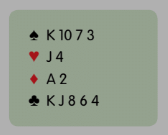
West could easily hold too good a hand to pass but too little shape to take unilateral action. A double then fits the bill. Since raising partner’s suit takes priority, West will typically have tolerance rather than support for hearts. It will be usual to have something in both unbid suits, especially in an unbid major.
A possible hand is this:
(b)
| West | North | East | South |
|---|---|---|---|
| 1♣ | 1♠ | — | 2♥️ |
| Dbl |
In Auction (b), where South’s 2♥️ is forcing, it makes no sense to play double as for penalty. Again West’s double shows sufficient values to be wanting to compete, normally with something in partner’s suit and in the unbid suit.
A possible hand is this:
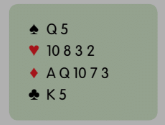
West hardly wants to bid 3♦️ and risk finding East short in the suit. A raise with only a doubleton spade or a 2NT bid with these values could lead to trouble too.
What does the doubler’s partner do? Continuations (unless in opposing suits) are natural. Partner tries to show undisclosed length or, lacking any, to keep the bidding low. Since these doubles are take-out in nature, partner does not leave in the double without a good trump holding.
You can play competitive doubles in other situations too. The above are just two of the most clear-cut for playing them. Once you have added these to your repertoire, you can investigate others.